Lloyd And Paul Waner
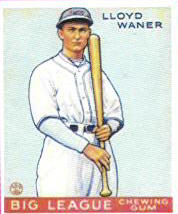 CLICK HERE FOR LLOYD WANER'S STATS |
(Left to right) Lloyd Waner, Babe Ruth, Paul Waner, and Lou Gehrig shake hands before the beginning of the 1927 World Series between the New York Yankees and Pittsburgh Pirates.
|
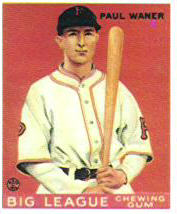 CLICK HERE FOR PAUL WANER'S STATS |
A WORLD SERIES AGAINST THE BEST!
The Waner Brothers Outhit Ruth And Gehrig
In 1927 World Series Between Yankees And Pirates
by Darl DeVault
Oklahoma Sports Museum
| Two brothers from Harrah, Oklahoma, Paul Glee and Lloyd James Waner, used their track-star speed on the basepaths to out hit Babe Ruth and Lou Gehrig in the 1927 World Series. Playing in the same outfield for the National League pennant winning Pittsburgh Pirates, the speedy Waners made a huge contribution in '27. Paul was the spark of that pennant drive, leading the league in batting with a .380 average, 131 runs batted in, and 237 hits. He earned the National League Most Valuable Player award, the first MVP for an Oklahoman. And Lloyd was not far behind that World Series year, hitting .355 and leading the league in runs scored with 133. That famous foot speed paid dividends that year, when Lloyd set a modern National League record of 198 singles. He would also lead the league in hits in 1931 with 214. The Pirates played the star-laden New York Yankees, which many have called the greatest team ever, and were swept 4-0 in that '27 World Series. The '27 Yankees featured six future National Baseball Hall of Famers: Ruth, Gehrig, Tony Lazzeri, Earle Combs, Herb Pennock and Waite Hoyt. |
In "The Glory of Their Times," a book written by Lawrence Ritter in 1966, Paul talked about the reception they received upon arriving home in Oklahoma in late '27: "Mom and Dad and Lloyd and I went back home to Harrah and darned if they didn't have a parade for us.
"Everybody was so happy that I was hard put to figure it out. After all, we hadn't won the series; we had lost it in four straight games. Well, it turned out there had been a lot of money bet, but it hadn't been bet on the Pirates against the Yankees. It had been bet on the Waner brothers against Ruth and Gehrig, and our combined batting average for the series had been .367 against .357 for Ruth and Gehrig... so money was won and that's why everybody was so happy."
The Waner brothers, billed as the "Waner Wonders," went on a successful vaudeville tour with Ruth and Gehrig following the series. Paul played the saxophone and Lloyd the violin. The tour ran for 16 weeks in major theaters across the northeast.
"They talked about it and said they had a good time, but neither of them had any professional training in music," said Ruth Waner Formby, the Waner's littlest sister, who spent her life in Harrah.
Paul and Lloyd, "Big and Little Poison" as they were respectively nicknamed, were terrors to major league pitchers during the 1920s, '30s and '40s. There are many different stories as to how Paul and Lloyd got the nicknames "Big and Little Poison." Many believed that it was because Paul was never known to pass up a party or because major-league pitchers considered them poison, but their sister said otherwise.
"I've heard a lot of different tales, but the truth of it is people were so intrigued that they were brothers and that they were good ball players, too," Formby said. "When they played Brooklyn, the Brooklynites in their own language called them Big Person and Little Person, but when they said it, everyone picked it up as 'poison'."
Both Waners had excelled in track in their public school career in Harrah. The brothers roamed the outfield for the Pirates for 14 years while setting records at the plate for hitting and burning up the basepaths as arguably the fastest men in the game. It is their track-star speed that many point to as raising the standard of play in Major League Baseball (MLB).
Heine Groh, a veteran of six World Series with three different clubs at the time, played on that 1927 team with the Waners.
"That was the first year both the Waner boys were in the outfield for Pittsburgh, and it sure was a delight to watch those two play baseball," Groh said. "Criminy sakes, could they ever hit! No bloopers, either. All line drives. And both of them fast as antelopes."
At the beginning of Lloyd's career, a newspaper reporter stated that it was guaranteed that he would reach first base if his bat hit the ball because he was too fast to be thrown out. This nearly proved to be true as Lloyd led the National League in singles in '27, '28, '29 and '31, to set a modern major-league record.
The Waners are also the only brother tandem enshrined in the National Baseball Hall of Fame in Cooperstown, New York, and have been credited with changing the game of baseball. Together, their 5,611 major-league hits are the most of any brother combination in baseball history-- a total of almost 1,000 more than all five Delahanty brothers and 500 more than the total of all three of the DiMaggio brothers.
Paul's total of 3,151 hits lifetime was exceeded by only six men in the history of baseball. Only five men exceeded his output of doubles and only eight were able to hit more triples. Paul still holds the MLB record of most consecutive games with extra-base hits from when he went 14 straight games in 1927 with extra-base hits. Paul shares the MLB record for most doubles in a game (four) with many players. Paul had the most hits in MLB in the 1930's. Lloyd still holds the MLB record for most hits in a rookie season with 223.
And that famous foot speed paid off on defense, setting standards in the field. Because of their speed and ability to get under any flyball not headed out as a home run, they were almost flawless fielders. Lloyd set a MLB record for putouts in a doubleheader by a center fielder when he caught 18 outs on Aug. 25, 1935.
The Waners were not known for power hitting, mainly because they were small. That does not mean they could not hit the long ball. The brothers were the first sibling duo in major-league history to hit home runs in the same game. They accomplished this rare feat twice, first in 1927 and again in 1931. Lloyd, who was inducted into the National Baseball Hall of Fame in 1967, only weighed 132 pounds when he reached the majors. Paul was not much bigger than Lloyd at less than 150 pounds and five feet eight inches tall.
Because of their speed the brothers were always among the league leaders in doubles and triples. They had that rare ability of being able to round first, and unless the ball was in the air towards the second baseman, be sure of having a double.
This ability to get on base helped the Pirates to many successful seasons. During Lloyd's 19-year major-league career, he struck out only 173 times and ranks among the all-time best leadoff hitters.
The brothers finished their careers in 1945, on different teams, but the years with the Pirates were their glory years. "Big Poison" Paul, who was inducted into the National Baseball Hall of Fame in 1952 and died in 1965 of pulmonary emphysema, finished with a lifetime batting average of .333. That matched his average against the '27 Yankees.
"Little Poison" Lloyd hit .316 over a span of 19 major-league seasons after hitting .400 against the '27 Yankees. Paul stayed in baseball as a hitting coach until the time of his death in Florida. Lloyd returned to Oklahoma after his playing career, where he retired as a clerk for the City of Oklahoma City in 1967. He died in 1982.
Although they did not hit for power, "Big Poison and Little Poison" outhit and outhustled all of baseball consistently enough to earn themselves a place in the Hall of Fame and the modern-era record book. The brothers were inducted into the Oklahoma Sports Hall of Fame in 1991. The duo are also well represented in the recently opened Oklahoma Sports Museum in Guthrie, with prominent displays of these National Baseball Hall of Famers.
The front window of the west gallery exhibits a traveling trunk donated from the Waners' careers. Paintings of the brothers, donated by Lloyd Waner Jr., hang above their personal-model bats in a display of the bats of the eight Oklahomans in the National Baseball Hall of Fame. Replicas of their plaques in the Hall of Fame in Cooperstown and a story about their careers are also on display.
Baseball Todd's Dugout Main Page!