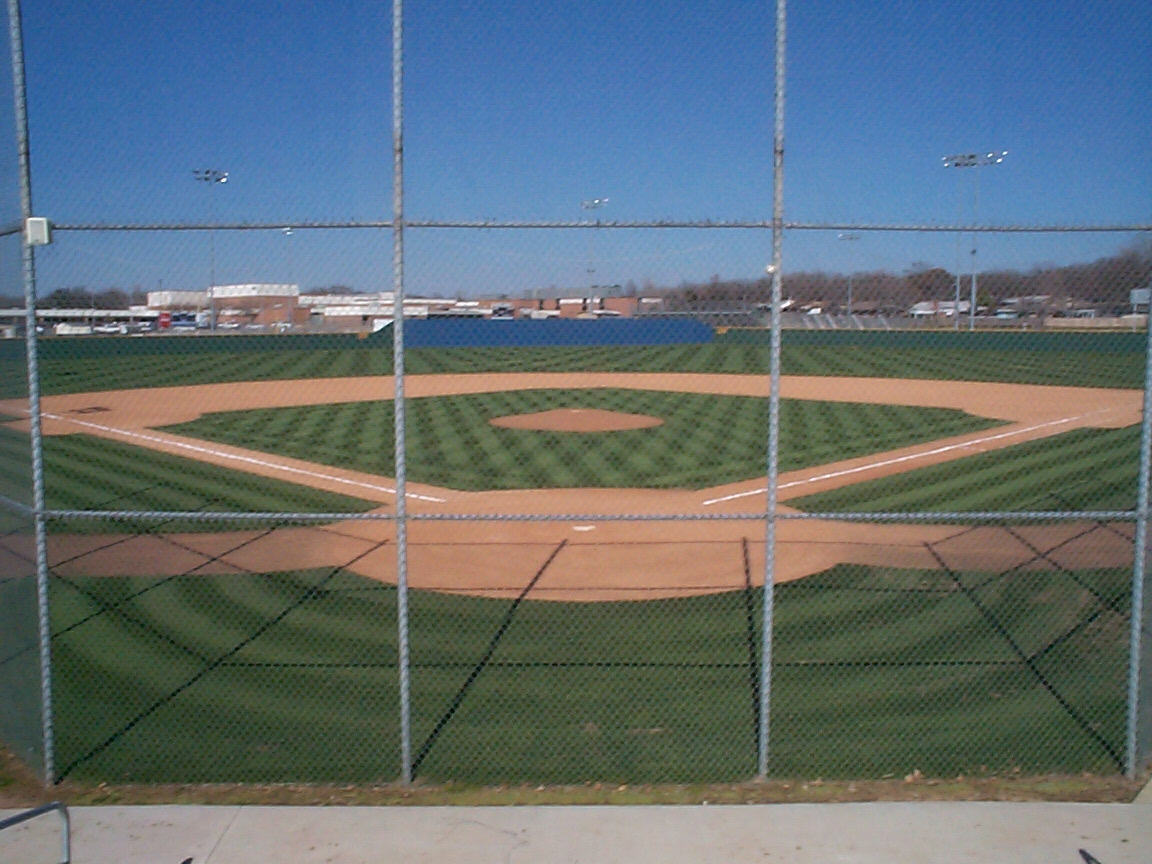
Rick Newville's Field of Dreams
 |
|
Two years ago, Rick received national recognition for his groundskeeping work while an assistant at Putnam City North High School, one of PC West's sister establishments. PC North's field was proclaimed the 1998-1999 National High School Baseball Coaches Association Field of the Year. The field also was named one of the top three fields in the nation by Beam Clay and Sportsturf Magazine. Rick himself was named 1998-1999 BCA National Groundskeeper of the Year.
Rick also led the PC North Triple-A American Legion baseball team to the Triple-A American Legion state baseball title in 1998 with a 25-22 record. It was North's first-ever baseball title in either spring or summer play.
Rick's most recent award for his groundskeeping prowess is the Sports Turf Managers Association 2001 Baseball Field of the Year Award for the high school/parks recreation division. Below is the story from the March 2002 issue of Sportsturf magazine. Visit both Sportsturf or the STMA online.

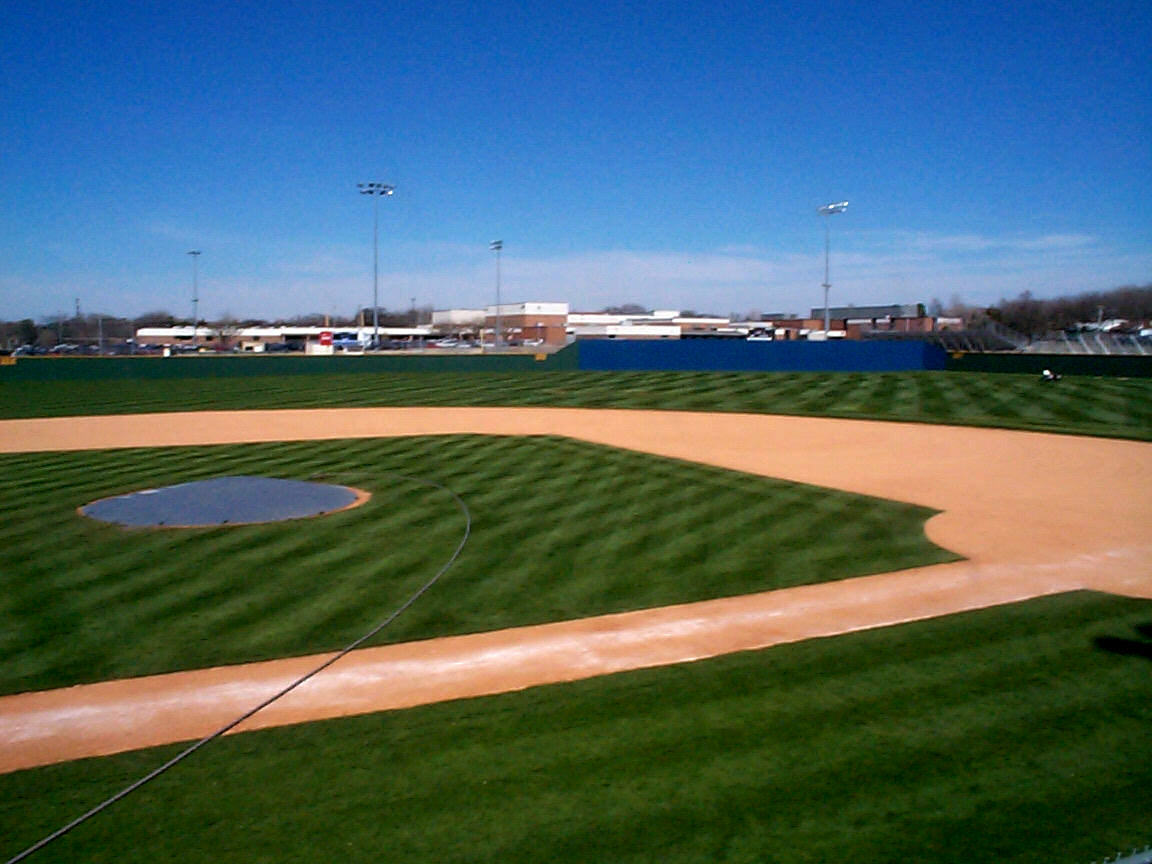
Patriot Field of Putnam City West High School, Oklahoma City, OK, earned the STMA 2001
Baseball Field of the Year Award in the High School/Parks and Recreation Division.
Rick Newville joined the school's four-coach baseball staff in August 2000, transferring from
Putnam City North. He teaches biology to sophomore and junior students as well as coaching.
The field care aspect of his role has been building for quite some time. The interest was sparked
when Newville, and his friend Monte McCoy (now sports turf manager for the Oklahoma
RedHawks Baseball Club) played college baseball at El Reno Junior College (now Redlands
Community College). Newville moved on to complete his bachelors degree in science education
at the University of Oklahoma and began teaching and coaching within his current school district
in August 1994. He and McCoy coached American League baseball together in Norman, OK,
then McCoy headed the program that earned the Beam Clay Diamond of the Year award for
Oklahoma University.
Newville says, "My science background enables me to work with the concepts of field
management and the hands-on labor turns those concepts into action. Seeing the impact of field
maintenance on safety and playability got me hooked. And, working with students gives me the
ability to use the field care aspect as another educational tool."
Patriot Field was constructed in 1969, following the opening of the high school. The soil profile
is the native loamy clay. There's no crown on the field, but there is a slight run off from right to
left field. Infiltration and percolation rates are generally adequate to handle the spring rainfall.
There was only one rainout in the 2001 spring season. Initially the baseball outfield doubled as
the auxiliary practice field for the football team. It's now dedicated to baseball and a lot of it.
USED 10 MONTHS A YEAR
"Summer League began on June 1, and Patriot Field served as the home site for three teams, and
hosted a week of youth camps. From April 1 to the end of July, 70 games were played. This
included two tournaments that put 30 games on the field within a 12-day period. The field got a
much-needed rest from August 1 until October, when the preseason tryouts were held to start the
cycle once again. So, over the 2000-2001 baseball season, Patriot Field hosted 130 games and
three tournaments, and served as practice site for the multiple teams."
Key field improvements, coupled with the aggressive maintenance program enabled
Patriot Field to stand up to all this use. This program is put into action by the four coaches,
one student assistant and help from the players for major projects and during
tournaments.
Newville says, "Our student groundskeeper, Brian Rudy, is a great asset. He started with
no field maintenance background, but has become proficient in all areas, including
rebuilding the mound and home plate, dragging the skinned areas and lip control.
Maintenance begins at 11:30 each morning and the field must be playable no later than
2:30 PM. That includes the entire mound, plate and skinned area preparation and the
mowing. Each of the five of us tackles an area, generally performing the same tasks each
day. Coaches Brian Aylor and Jim Taylor, along with myself, focused a majority of our
attention on the skinned areas as most of the game is played on the skinned surface.
"Aesthetically, the ryegrass patterns always catch peoples attention, but we really pride
ourselves on the playability of the skinned area. All of us join in the post-game clean up
and in tarping. We all work the tournaments to insure top conditions and keep things on
schedule."
An in-ground irrigation system was installed in the outfield in 1998. The infield had only a
quick coupler to which an impact head could be attached. The hot, dry summer, limited
irrigation resources, and a minimal mowing program left the common bermudagrass field
struggling. Shortly after Newville came on board, he extended that in-ground system to the
infield. He trenched in piping and tapped into two existing valves located directly behind
the infield skinned area. He added eight heads in the infield, four attached to the left
outfield irrigation section and four attached to the right outfield irrigation section. While
irrigating the outfield and infield sections together is not the ideal situation, it does provide
a more workable irrigation source to combat the regions hot, dry summer conditions.
The next project was reconstruction in front of the pitcher's mound to remove a hump that
had developed over time and to bring the slope back to the precise regulation dimensions.
Then it was on to lip removal. Newville says, "The back edge of our infield was sitting at 95
feet. We took 5 feet off the sod to extend the skinned area, cut out more skinned area
around first and third, put in the cutouts for the umpire boxes, and created walkways from
the dugout to home plate area."
By late September, Newville was ready to upgrade the common bermudagrass by
overseeding with a blend of perennial ryegrasses. He says, "This is when the adversity
really kicked in. It's the single word that best describes the conditions our staff had to
overcome to provide a safe, playable, and aesthetically pleasing field. And those were our
three goals, in that order of importance."
The field was core aerated. Then the outfield was overseeded at the rate of 8 lbs. per
thousand square feet, and the infield and wings at the 10-lb. rate. This was followed by a
topdressing with sand at the rate of 1/8-in. October brought almost 12 in. of rain, beginning
right after the perennial ryegrass had germinated.
ICE STORM COMETH
This one-two punch knocked out some of the perennial ryegrass necessitating spot applications
of pre-germinated seed in March.
By February 2001 weather conditions had improved enough to upgrade the skinned area clay. At
least 50 tons were added and tilled in to bond with the existing material. This was topped by 3
tons of calcined clay, the area reworked and then rolled with an asphalt roller.
In the meantime, spot treatment was used to battle compaction. Rudy tackled this assignment
whenever he could fit in a few minutes. He used a half-inch drill bit on a power drill to open up
the areas that were too hard for standard aeration. The openings were filled with the same coarse,
washed sand used in the topdressing program.
This process, combined with spot irrigation, brought these sections into good enough condition
for working with the walk-behind aerators. These machines also are used for the wings and the
infield while a tractor mounted unit is used for the combination slice and core of the outfield. A
pull-behind unit is rented for slicing only of the outfield.
Newville says, "Our biggest surprise came on a Saturday morning in May. Heavy rains overnight
brought us in early to work the skinned area. We discovered a drunk driver had crossed through
two cyclone fences and put his truck on the third base wing, then managed to drive away. We
were left with fences that needed repair, tire tracks, a few oil spots and the one of the metal
letters of truck maker's name."
Newville approached the Booster Club with a proposal to enter into and fund a lease purchase
agreement on a 68-in. triplex reel mower for the outfield and a 25-in. walk-behind reel mower
for the infield. He says, "This was a pretty big step for our Booster Club. I showed them the
improved turf conditions a similar combination had helped us achieve at Putnam North. That
information, coupled with the positive initial changes the aggressive maintenance program was
producing, motivated them to step up to the plate. We started mowing with the triplex in early
November 2000 and added the walk-behind in January 2001. We can now mow every day to get
the consistency and quality we're after."
The reel mowers also help with the transition back to bermudagrass. Mowing height is gradually
lowered to 5/8-in. This combined with core aeration, the regular fertilization program, and
Mother Nature's heat phase out the ryegrass as the aggressive common bermudagrass bounces
back.
Newville notes that the school district, under the coordination of Dee Wilson, Putnam City
District athletic field manager, provides a finite amount of fertilizer, seed, conditioner, and the
field marking chalk. The third source of materials comes through an arrangement worked out
with Jeff Foster, David Bonds, and Larry Lindsay of Estes Inc., a local distributor. The company
provides additional seed, fertilizer, conditioners, herbicides, fungicides, and pesticides, along
with consultation services as needed, in exchange for an advertising sign posted at the field.
Also over the past 2 years additional improvements have been made. Lights have been installed,
a permanent outfield fence was erected, and new bleachers have been added. Future projects
include: adding a warning track to the wing areas, moving existing bullpens to the outfield, and
installing larger dugouts.
Newville has future projects on his mind as well. He'll continue for the third season as a member
of the field maintenance staff for Oklahoma City's AAA Stadium, Southwestern Bell Bricktown
Ballpark. And, he'll tackle a new field and new challenge moving from the baseball coaching
staff to serve as head softball coach.
He says "After working with the RedHawks, I've been determined to bring that same level of
safety and playability to our fields. My goal is to provide the safest facility for everyone that
comes in to play. Monte's been an excellent resource to help make that happen. I've also just
come back from my second STMA Conference. The networking is excellent. It's an unbelievable
resource to make the connections so you can just call someone up to exchange ideas and get
information. It's an ongoing education process."
Newville says, "Patriot Field is utilized 10 months out of the year. Tryouts for the school
baseball teams are held in October, and the teams practice thereafter, weather permitting.
Practices continue until the first games are played around the first of March. In 2001, from
March 1 to mid-May, the field hosted the varsity, junior varsity, and freshman teams who
combined for a total of 60 games, including one tournament. All the practices for the three teams
were also held on the field. The field then saw a 2-week break from game, but played host as a
batting practice site for smaller schools playing in their state tournaments.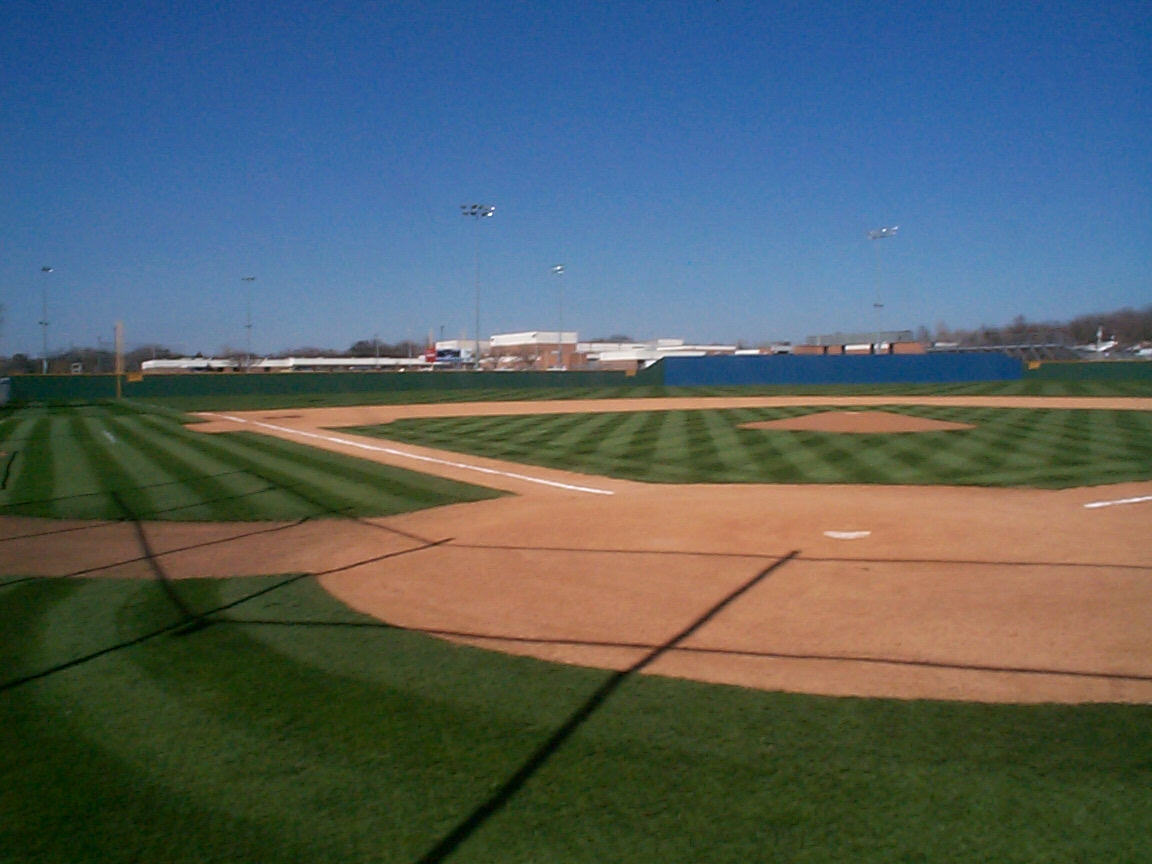
"My science background enables me to work with the concepts of field management and
the hands-on labor turns those concepts into action." Rick Newville
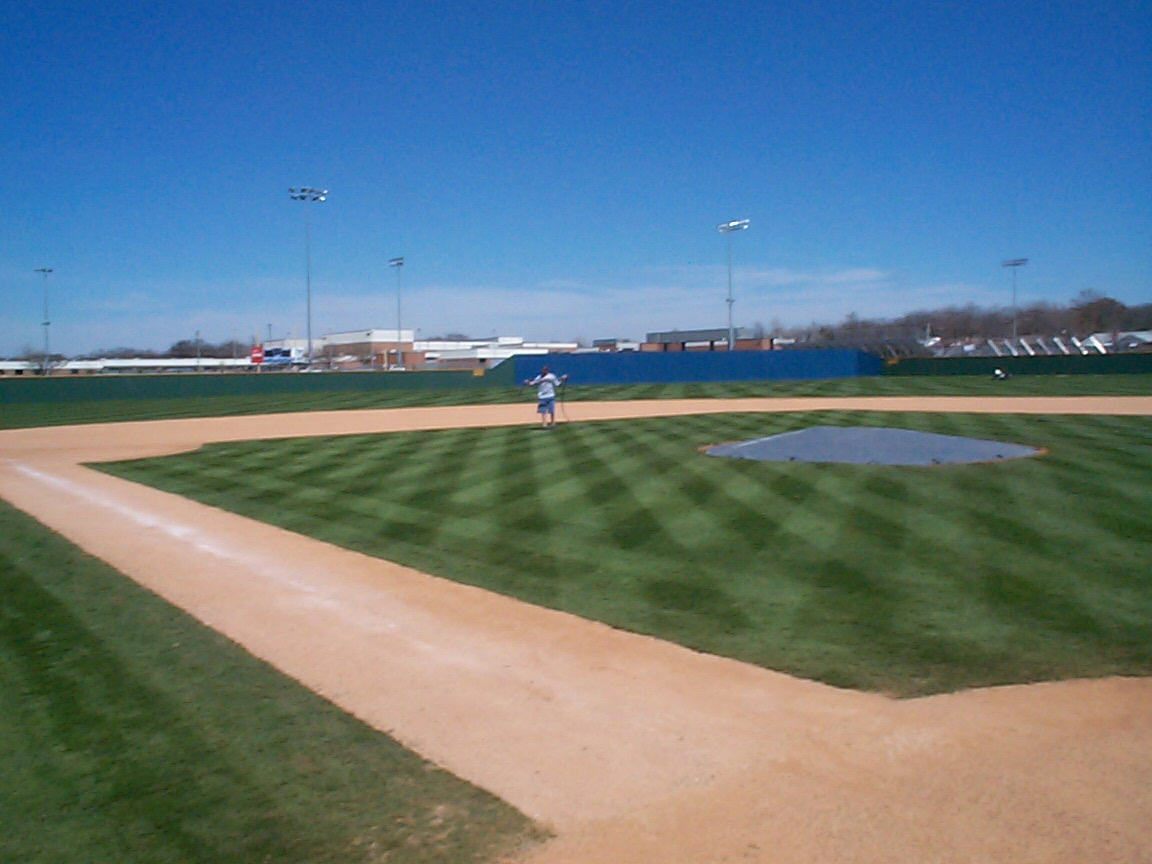
The first ice storm hit right at the end of Christmas break. Additional ice storms followed in
January. Most areas of the field were covered with about 1 in. of ice, but in other sections the ice
build up reached 3 in. Newville says, "We had to chisel ice away from the irrigation heads so we
could use the irrigation system to speed up melt down whenever temperatures rose above
freezing. In the shaded areas, such as in front of the dugouts, the ice lasted so long we had to put
our student groundskeeper to work chiseling it away."Over the 2000-2001 baseball season, Patriot Field hosted 130 games and three tournaments, and
served as practice site for the multiple teams.
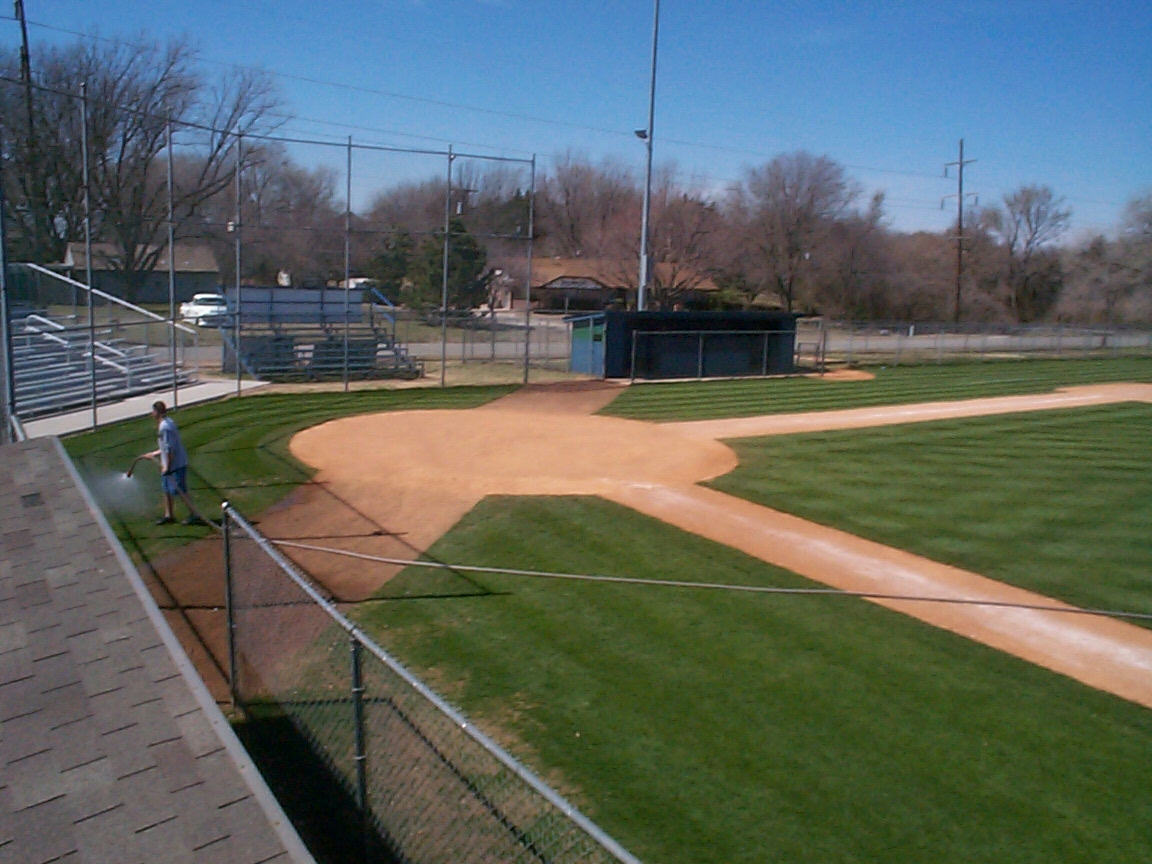
The first ice storm hit at the end of Christmas break; more ice storms followed in January.
Most areas of the field were covered with about 1 in. of ice.
Of Sportsturf Magazine |
 |